Andrea Mantegna – the Agony in the Garden
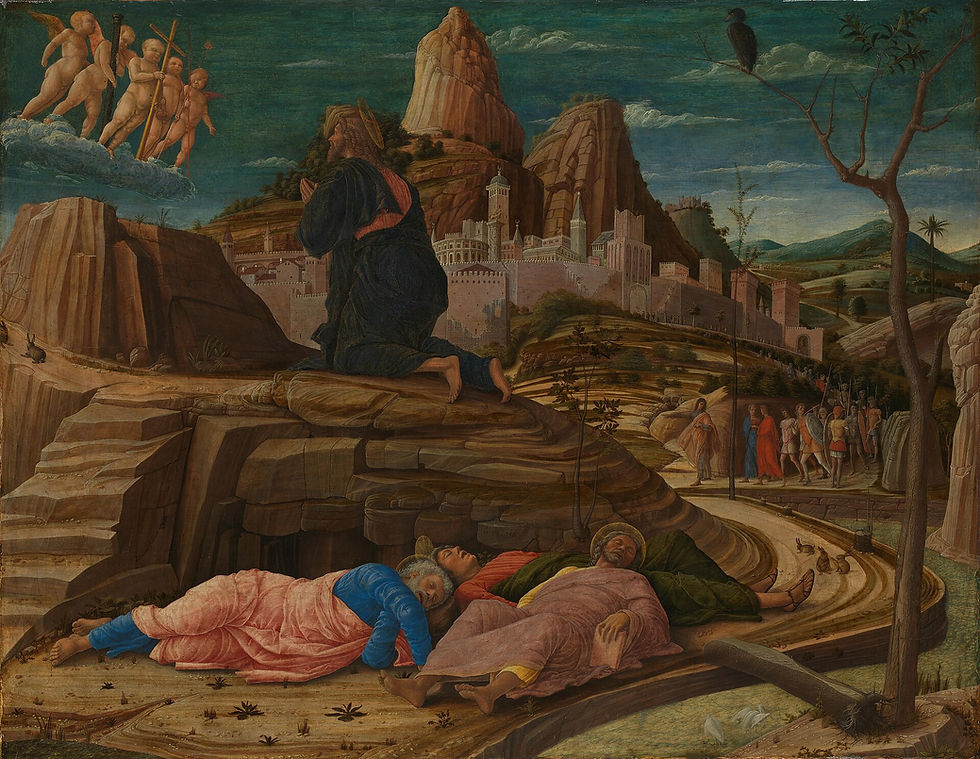
This narrative painting shows us the figure of Jesus praying to God the Father that he might be relieved of the terrible fate that lies in store for him. In response, a posse of cherubs sent to stiffen his resolve is seen at top left, born aloft by a cloud. Rather than providing succour however, by this account they instead only signal foreboding. The leading putto carries a crucifix, a portent of the manner of death that will be suffered. Another one shoulders the scourging post at which Jesus will be flogged before being nailed to the cross. A third holds a sponge on a stick, soaked in sour wine, which will be offered to the dying Crucified One either as an act of mercy or mockery while a fourth carries a spear which a Roman soldier will thrust into Christ’s body to verify his demise. These little fellows are not exactly good news messengers.
The Agony in the Garden episode is a critical moment in the Passion, and highlights Christ’s faltering humanity as well as the weaknesses of three of his apostles and the cupidity of a fourth. According to the gospels, having partaken of the Last Supper, Jesus asked Peter, James, and John to stay with him, looking for their support by having them accompany him into the Garden of Gethsemane, near the Mount of Olives. There he implored them to stay awake with him just for an hour while he prayed, his mind tormented with thoughts alternating between irresolution and resignation. In the event, he felt let down when his friends fell asleep while acknowledging that their ‘spirit is willing, but the flesh is weak’. It was as if Jesus alone knew what would befall him while his devotees had scant inkling and took their lord’s premonitions insufficiently seriously.
The foregrounded figures in this painting of the setting by Andrea Mantegna, awkwardly depicted in my view, show us the three unreliable if well-intentioned acolytes. Meanwhile, in the right middle ground we can see Judas Iscariot leading an arrest party, having betrayed Jesus to the Sanhedrin authorities. According to the story, it was they, the Jewish councilmen, who felt threatened by Jesus’ growing following in Judea and by the (false) notion that he aspired to become ‘King of the Jews’. The risk to political and social instability that this might cause, especially during Passover, gave them the cover to portray Jesus as an insurrectionist to the Roman occupiers. In exchange for thirty pieces of silver, Judas has promised to guide the persecutors to Jesus’ location and to identify him by a kiss. It is a scene of high narrative drama.
I think that awkwardness of the recumbent characters lies in the artist’s apparent desire to demonstrate the cleverness of his foreshortening technique even at the expense of verisimilitude, by showing the figure of St John pointing his feet almost in our direction. This is an approach that was carried off to greater effect in the artist’s later work, The Lamentation over the Dead Christ.

In The Agony, it looks as if those feet are hardly in touch with the earth, and the leg positions are unconvincing even if the folds, rumples, and wrinkles of the clothing are carried off masterfully. My reservations do not prevent my appreciation of this superlative artwork however and after all, the realism of a picture’s subject is not the same as its truth.
For instance, those rock formations don’t look authentic either but are deliberately rendered with the artful demands of the mise-en-scène in mind. With what look like steps that we can imagine Jesus treading in our mind’s eye, leading up to a small plateau, he kneels in prayer at an outcrop resembling an altar, a raised protrusion on which one might imagine animals sacrificed rather than it standing in as the sanctorium of God incarnate. The painted landscape looks theatrical, a stage set, which in a sense, it was, a place where a tragedy was played out. The saints’ halos also remain intact, undisturbed by their prostration. The depiction of the halo was an unrealistic element of artistic language by which the Renaissance artist could identify for the viewer those saints imbued with divine grace. So, the painting is not aiming for naturalism, even though it should be noted that Mantegna manages to make a visually convincing ellipse of the halo behind Jesus’s side-on head. The painting has another purpose other than representationalism: it seeks to highlight for us the unimaginable responsibility that lies on the saviour’s shoulders and while his disciples remain close, they cannot share it. He has their company but is separated, bearing the burden alone, forsaken. As if to reinforce the gloomy prognostications of the cherubs, a glint-eyed vulture sits atop an almost leafless tree, one of whose rotten branches already lies on the ground – death, treachery and faithlessness are in the air, and this heartless predator knows it.
More auspicious if a little bizarre, to modern eyes at least, the scene is also populated by clusters of more life-affirming creatures. Rabbits skitter playfully along the paths and must signify the new life to come with the resurrection. Long associated with fertility and prolific breeding, their presence here gestures at the absorption of pagan celebrations of Spring and regeneration into Christian teaching. Also, paddling in the stream that flows towards the right foot of the painting and almost unnoticed, we can see what scholars have identified as a couple of miniature white egrets. These symbolise purity, birds cleansed of sin by the coursing baptismal waters.
An anatopic collection of buildings straddle the lower slopes of the mountain. Less like the Jerusalem that in reality lay just a few miles away and more like the artist’s cosmopolitan citadel imaginings, they contain structures that include a mini-Roman colosseum and a column not dissimilar to Trajan’s. We can see a pyramidal spire that looks like St Mark’s campanile in Venice and another domed bell tower reminiscent of the Torre Bissara in Vincenza. This version of Jerusalem is the backdrop to Christ’s agony and although its fortified walls loom above him as the place where he will answer for his ‘crimes’, their plasterwork is distressed and seem ready to crumble. The size of Jesus’ own figure from the low-down viewpoint means that he dominates this stronghold – the painting tells us that his barefoot humility will prevail through the Atonement and the miracle of the Resurrection, against any vainglorious construction, any secular jurisdiction or temporal aspiration.
Some critics have speculated that the scene we are looking at is a composite vision, as dreamed by the sleeping apostles. This is a reading with which I don’t necessarily agree but it would account for the way that the edifices of the city are brought into unfeasible, proximity. They have the surreal, hallucinatory quality of super-fine detail and although magnificent in aspect, they are also formidably daunting. The long single-file of figures that process inexorably at the foot of the right-hand wall is similarly strange, and menacing and, as in a bad dream, we apprehend its collective condemnatory purpose without being able to rationalise its real cause.


Comments