Annibale Carracci – Boy Drinking
Annibale Carracci (1560-1609) was only in his early twenties when he made this painting, and it certainly demonstrates a certain youthful rebelliousness by violating artistic conventions of the time. Its subject is neither obviously religious nor mythological and so might have been thought unworthy of an artist’s attention in the period, and even if regarded as a portrait, it does not respect the earlier Renaissance tradition of showing figures of significance in profile nor the later custom of depicting three quarter face views. In short, for a late Renaissance work it feels modern. Its subject is depicted much more like some of Degas’ figures – think of his unusual viewpoints of circus performers or his capturing of the idiosyncratic limb positions of his ballet dancers or milliners.
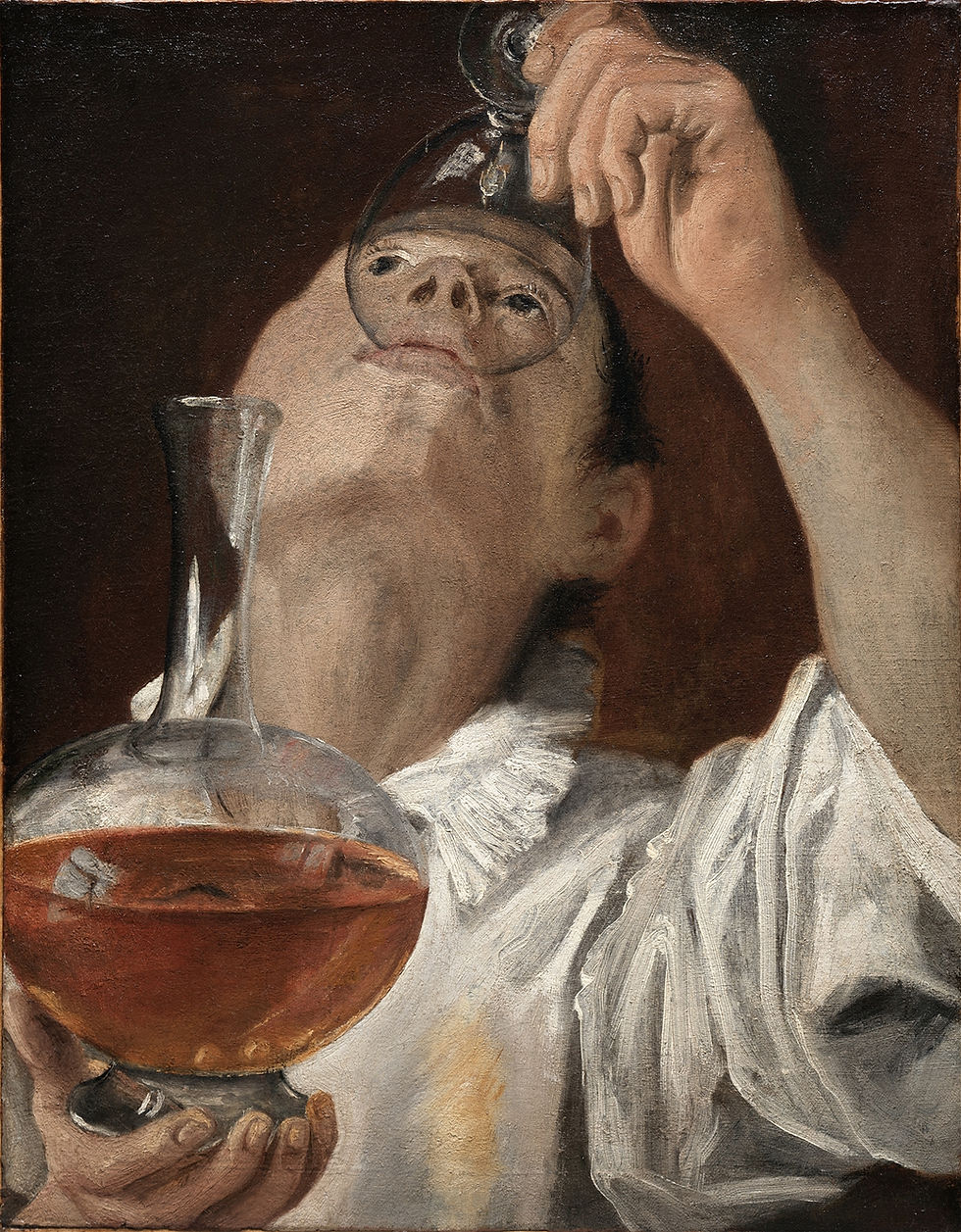
In this work we see a similarly unposed individual observed from an unorthodox standpoint. From low down, we look up at the exposed neck of a boy tilting his head back to drain the last few drops of wine from his glass. He holds it by its base, between thumb and forefinger, while in the other hand he holds a half-full decanter up at chest height. Has he just now taken a look at this container to judge whether or not his stealing of a measure will be detectable, while keeping any finger marks off the body of the glass?
The boy’s upwards-cast eyes are focussed only on the emptied glass and as viewers we are given a distasteful view up his nostrils, the uncouthness of which nevertheless makes us imagine the aroma caught in the glass as the last droplet has just passed his lips onto his tasting tongue. But alongside the physical senses conjured, our vantage point feels as if it were concealed, albeit close by, so that we are catching the boy in the act, silent witnesses to his crafty ‘crime.’
There is also a sense of spontaneity in his relative state of undress, with his frill-necked chemise open at the neck, and his sleeves pulled back, its whites gleaming against the darkness. Such dishevelment and location prompts questions for the viewer. Is it nighttime or he is committing his impertinent act in a store cupboard or in a cellar? Is he a servant boy or a child of the wine-drinking master of the household? Either way, his drinking feels as if it is unauthorised and clandestine so that the amber reflection that shines from the flagon onto his shift is like a stain of guilt over his heart.
The line of the boy’s angled head and shoulder on the left is mirrored by his arm on the right so that the composition comprises a triangle with the top of the glass and the index finger at its apex. Within this shape another triangle is formed by the void to the right side of the head and the inside forearm, so that the idea of internal reflectance is underlined. Whenever a triangle appears in Renaissance art, the notion of a symbolic Trinity is never out of the question. But if it exists here, it is an unholy one. His apparent transgression tells us that, prima facie. At the top, what might have been the hand of God is replaced by the sinful hand of mankind, holding up above his head the glass that has tempted him into vice, like a parody of the elevation of the chalice during Mass, the moment of consecration. The boy is someone’s son, if not God’s, and the wine he holds is a source of sin. ‘Do not get drunk with wine, for that is debauchery, but be filled with the Spirit’ says the New Testament (Ephesians 5:18), advice which the boy ignores in pursuit of a different kind of spirit.
While looking at the way the boy holds the pitcher, I was also reminded of the controversial Leonardo da Vinci artwork, Salvator Mundi. Boy Drinking is like a mockery of this.

The orb shaped flagon represents an alternative world to the one symbolised in the earlier painting, one in which oblivion will have to stand in for salvation in an anti-eucharistic way. The hand of Christ’s benediction is swapped for the left hand (the ‘sinister’ Devil’s hand) holding up a glass that represents iniquity instead.
Setting aside any (un)intentional references or symbolism though, the work feels modern because of the cropping of its subject matter. The top of the painting barely contains the hand while the upraised arm is cut off at the elbow. The boy’s right arm isn’t shown at all. This seems like snapshot photography avant la lettre. Some art historians have suggested that the small scale of Boy Drinking (55.8 x 43.7 cm) indicates that it must have been one of several bozzetti or preparatory sketches for a larger work made in the same period, most likely The Bean Eater.
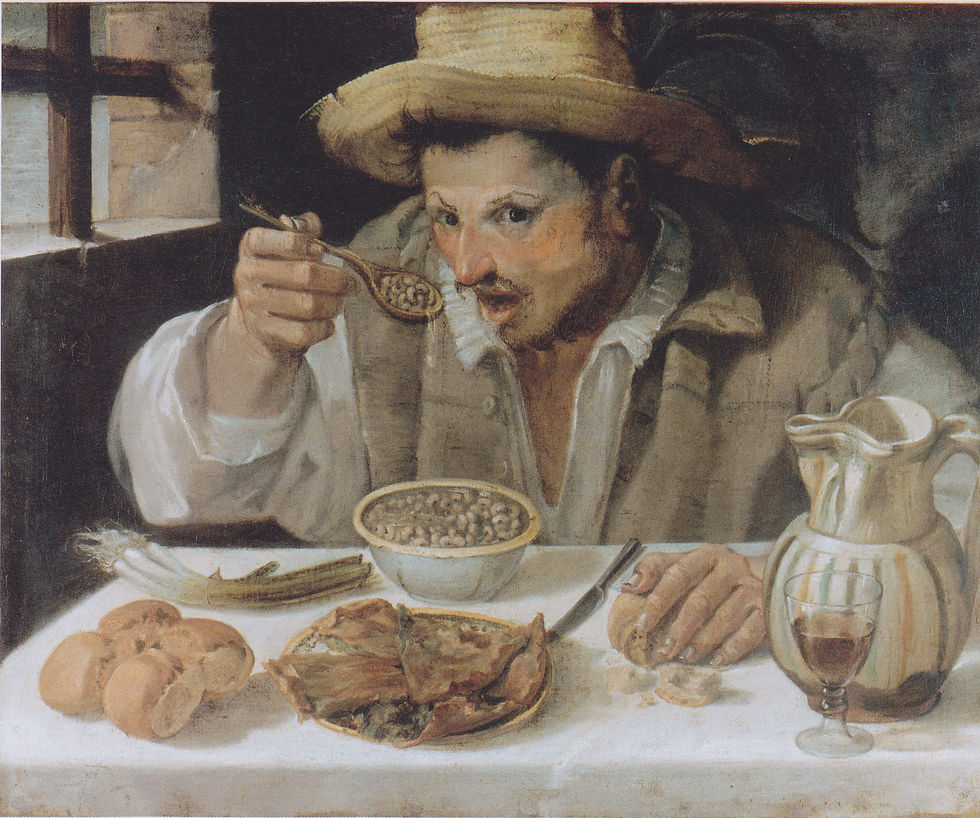
Although the artist is known to have made three versions of Boy Drinking (one of which was stolen from the Christ Church Picture Gallery at the University of Oxford in 2020) which might lend weight to this theory, it seems to me just as likely that the artist was so taken by his own artistic innovation that he repeated it.
In any event, the unguardedness of the subject, something about the informality of manner, the brazenness of intemperate dissipation, has caught the imagination of the artist and prompted him to capture it in paint. The result is a work of uncommon immediacy. His brush lays on the pigment thickly and confidently, particularly when painting the folds of the sleeve. The flesh tones are also rendered masterfully. The reddened hands, often an indicator of emotion or shamefulness in art, contrast with the relative sickliness of the face. The dark hair looks untrimmed and unruly while the eyelashes appear to have been slightly enlarged by the glass’s magnifying effect. The foreshortening of the fingers and the bottom of the glass are worthy of Raphael, an artist whose practice of studying from live models and whose resulting naturalism Carracci deeply admired.
Working in a period when Mannerism in art had been all the rage (see my essay on Alessandro Allori’s painting of Lucrezia de’ Medici for comparison), Carracci seems to have rebelled against its artificiality, its privileging of elegance, sophistication and artifice over the directness, reality and emotion he preferred. On the other hand, this isn’t a conventional portrait either. It doesn’t give us a recognisable ‘likeness’ not least because the boy’s features do not face us – they are pointed heavenwards (but even his own sight of God is occluded by the obstruction of the glass). Although I think that this painting can be read in the context of religious thinking, as demonstrated in the foregoing, I don’t think it is a moralistic work. It does not condemn the boy’s behaviour in my view, but delights in his cheek. It might allude, albeit very obliquely, to Christian motifs but in the end, I think that Carracci, still a young person himself, identifies with the audacity and insolence of his subject and brings some of that attitude coupled with a degree of satiric wit, to the art-making ‘wisdom’ of the time.


Comments