Pierre Bonnard - La Terrasse ou Une terrasse à Grasse
- Jun 2, 2025
- 5 min read
I began writing about this work back in the winter on a depressingly cold and drizzly-grey February day in England; I was revelling in the painting’s apparent warmth and in the exuberant colour of its depiction of a terrace and its view of the refulgent south of France. Just spending some thoughtful moments in the presence of this scene acted like a tonic, and for reasons I can’t now recall, I left the piece to complete another day, perhaps rejuvenated enough to pursue other topics. Returning to it now, I am reminded of the therapeutic power of art, and in particular, of how great artists can arrange colour in such a way that the spirits are lifted and one can find oneself transported to another time and place.

In preparation, I thought I would re-read Julian Barnes’ shrewd and insightful collection of essays Keeping an Eye Open and his retelling of Picasso’s rather dismissive estimation of Bonnard’s approach to nature. Barnes puts it so well when he says that in his art, Picasso was in the school of subordinating nature to his own authority, and who ‘singlehandedly steer-wrestles the Great Bitch to the ground’ while he (Picasso) judged that Bonnard was nature’s servant rather than its master. I agree with Barnes in that this should never be an either-or choice, and that Picasso was probably revealing some envy at Bonnard’s abilities when he expressed a preference for Matisse’s intellectual certainty about the application of colour while accusing Bonnard of an excess of mark-making sensibility. But, an outpouring of sensibility is fine by me when its emotional effusion is not over the top, embarrassing or uncomfortable (as satirised in literature for instance by Jane Austen in Sense and Sensibility), but when it is ameliorative, even curative. I don’t find Bonnard’s sensibility to be too much or self-indulgent, nor do I find it intellectually empty. I think his paintings are more like meditations on colour - stimulating to our visual sensitivity without being flashily sensational. They are both absorbing and by some alchemy, transcendental.
La Terrasse was painted in 1912 when Bonnard was in his mid-forties prime and a year after he exhibited his huge (407 x 456 cm) triptych Méditerranée in the Salon d'Automne, another painting set in the south.
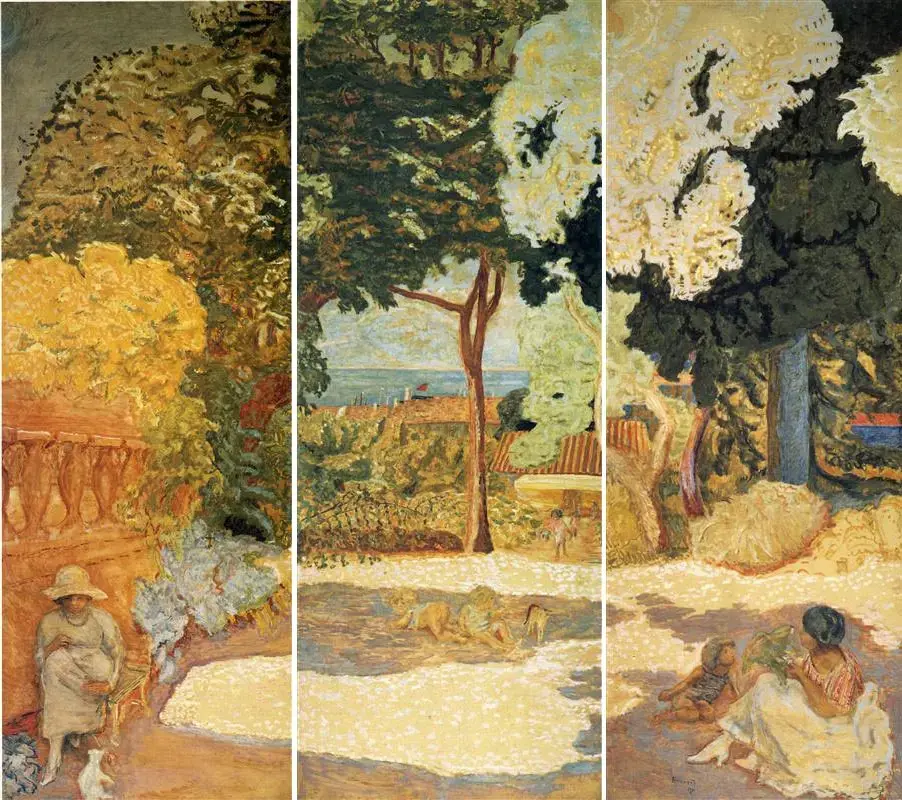
This had been commissioned by the Russian collector Ivan Morozov, and captures the same sense of luxuriance if not its languor. While Terrasse is much smaller (125 x 134 cm) it revels in a similar capacity to respond to a mood or feeling. It seems to me that both paintings (and by extension, many of Bonnard’s other painting too) are about moments in time. Of course, this is true of many non-abstract artworks, in that they seem to freeze-frame a view, but there is something particular about Bonnard’s depiction of the particularity of climate and the positioning and articulation of his figures and the disposition of objects within the context of an idyllic landscape that speaks of immanence in the moment. I don’t mean to suggest anything intentionally spiritual in these works, more that the artistic choices, the subjects, the framing, the colours, the mark making, all serve to re-create something of an epiphany, that may or may not have a divine aspect to it. These are unique moments in time, forever capable of transporting us, psychically at least, to share in them.
Terrace was made while Bonnard and his girlfriend and future wife Marthe were enjoying a holiday in Grasse where the weather and views of the seductive landscape has lured them both outdoors, and away from the artist’s usual preference for depicting domestic interiors. The canvas is bisected horizontally by the terrace balustrade, shown with a slightly tilted-away perspective, so that the painting retains a sense of the security of the villa’s domain while admitting a view of the wildness beyond it, and so that the viewer is conscious of the two realms sharing the moment, and of a dialogue between them.
On the terrace, Marthe is shown seated with her back to us looking outwards, relegated to the bottom right corner, her head protected by a hat while a few cats have the free run of the place. A series of plant pots line the edge of the terrace, two of which stand sentinel either side of the opening. These pots, containing flowers and shrubbery, are like domesticated versions of the untamed thicket of trees and underbrush in the distance. Marthe’s jacket is dark green as if in colour sympathy with the woods she is looking towards. The heaviness of that jacket might suggest that the temperature may not be as warm as we first suppose. In fact, despite the radiance of the terrace’s colours, the day depicted may be relatively cool. The sky is not clear, and one cloud in particular, outlined in white at top left and diametrically opposite Marthe, suggests that a rain shower threatens. In the very far distance, the Pre-Alp mountains of the Provence-Alpes-Côte d'Azur region are picked out with a cool mauve and suggest a freshening climate.
The French critic Jean Clair has written about Bonnard’s attitude to the passing of time and of his habit of noting the state of the weather day after day in his diary:
And if the moment comes alive in the descriptions either of the clothes that were worn or the state of the sky, on any particular day, it is not in that ‘time out of time’ – the exceptional or solemn occasion, the commemoration, rejoicing or festivity – but in all this pure time, this essence of time that constitutes the recall of what is usual, familiar, everyday, of what is consistently similar but never absolutely identical.
If Terrace is like an epiphanic moment in time, it is a moment without any particular significance. Unlike classical, religious or academic painting, the subject is not momentous. In fact, it reverses the idea of momentousness to find significance in an ordinary moment. Nor does it ‘merely’ exploit the en plein air optical sensations beloved by the Impressionists. It is post-impressionist in the sense that it moves beyond the immediacy of loosely brushworked light effect capture; it still manages this of course but it does more; it adopts a kind of Proustian approach to the moment. Just as Proust makes use of intense grammatical complexity and detail to conjure up a memory, so Bonnard’s colouration, his carefully detailed colour juxtapositions, arrive at a feeling, or to use Picasso’s term, they communicate a sensibility. Bonnard’s temps are not so much perdus as made into perpetually present moments in paint.
The Proust analogy may not be too fanciful. I just read up about Grasse, where Terrace was painted. It’s a place which had been the centre of the perfume industry since the eighteenth century and ‘produces over two thirds of France’s natural aromas’. Perhaps Bonnard felt at home in a place redolent of the perfumier as artist, where more than 2000 different kinds of scent can be combined to create a perfume, any one of which or any combination of which can transport us to another time and place in the mind – and definitely far away from a wet English February.


Comments