Bernardino Campi Painting Sofonisba Anguissola
This profoundly meta work is befuddling both intellectually and visually, and I can’t stop looking at it. During its restoration in the late 1990’s, its curators discovered that the artist had originally painted the female figure’s left arm in a different position and decided to leave this visible for a time so as to reveal something to us about the artist’s thought processes during its making, only to paint it out again in 2002. The image above shows both left hands, while the final version in Siena now only shows the hand hanging down holding a pair of gloves.
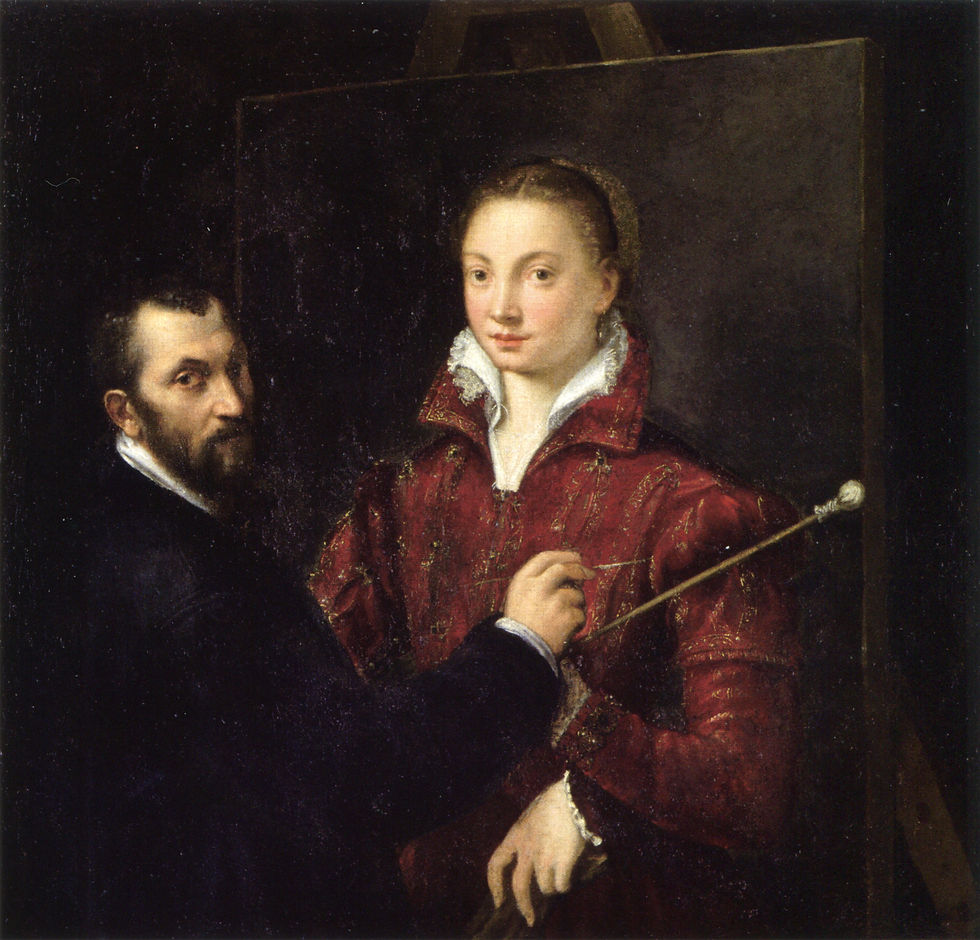
It is a painting by Sofonisba Anguissola which shows her teacher, the Cremonese artist Bernadino Campi, painting her portrait. From one perspective, it could be viewed as a straightforward pupil to teacher homage, a way for the young woman to express her thanks to the man whose portrait style influenced her own and whose guidance was invaluable to her. There is little written about the nature of their pedagogic relationship although I do think it significant that he was just ten years her senior. Seen from another angle therefore, the work could also be seen as a way for the pupil to demonstrate that she has outgrown her master. But there is something in the way that the painting within the painting takes on a life of its own that I find mesmerising. The angled picture plane of the ‘inner’ portrait seems to jostle with the plane of the actual painting so that the subject of Sofonisba seems to me to be more alive than the depicted painter making the image.
One reason for this may be the straightforward fact that the painted Sofonisba figure is bigger and much more prominent than Campi’s. She dominates the centre of the work, with Campi’s pallid-faced form relegated to the shadows off to the side. It feels to me as if she is about to walk out of the picture that has been painted, to come to life as some larger-than-life spectre, to inhabit or assume a selfhood to which she feels fully entitled. She towers above him, amazonian in her ascendency. She is dressed in the finery of an aristocrat rather than the plain black that she wears in other Anguissola self-portraits. It has been speculated that her unusually opulent costume in this work was a kind of sartorial emboldenment, a self-promotion made on or before her appointment to the Spanish court. In any event, the richness of her dress contrasts markedly with Campi’s humble attire, so that her superior power, authority, and rank is gestured at.
The other way of looking at this is to see Campi as a Pygmalion, bringing his pupil to life as an artist. But it is Anguissola who is the true Pygmalion, as it is she who has done the envisioning here. Both painted figures stare back at the viewer, as if challenging us to decide who has made whom and which of them is the greater artist. The figure of Campi is shown to be in the vacillating moment between looking back at his sitter, the artist, and by extension at us the viewer, and looking at his painting. Anguissola the artist has painted herself as the model but not in a conventional self-portrait manner, but interpolating Campi between us. She too stares back at us but at one more remove – this is Anguissola’s view of Campi’s view of her. We cannot know whether she has tried to impersonate his manner or whether she has remained true to her own style. In one sense, Anguissola’s has painted herself into existence. This is not so much ‘I think therefore I am’ as ‘I am because another sees me.’ At the same time, it is more assertive than this idea suggests. The subtext of this work is that she is the creator of her own identity and although Campi may have helped he is no longer instrumental in its future maturation.
There is a clear significance in the way that the subject of the painting within the painting was at one point shown holding the maulstick, the end-padded rod device used by artists to steady their hand by resting it against the canvas and lightly leaning on it. This lends the subject in the work a sense of agency; she actively participates in the making of the painting of herself and of course, it is actually Anguissola who did paint it! It is he who leans on her support. This militates against the idea of Anguissola’s diffidence. This is not, in my view, a self-effacing work, a self-depiction humbly mediated through another’s artistry. It is more like a mockery of artistic insecurity, a knowing proclamation of the female artist outstripping the male teacher – in deference, he has relinquished to her the maulstick baton (albeit that her grasp of it is not immediately visible) which she holds sceptre-like as if to reinforce her regal bearing. Campi is shown to be serving the reputation of Anguissola and not the other way round. Her aristocratic apparel and painted stature are visible reminders of the status reversal between the figures. This situation reminds me of the scenes played out by some of the smart female characters in Shakespeare’s comedies, like Rosalind in As you Like It or Beatrice in Much Ado About Nothing, women who use their wit and imagination to outshine the cocky men around them.
The more I look at this painting, the more I read Campi’s expression as one of approval-seeking. His paint brush is poised to add some additional gold paint to his subject’s dress, but all essentials of the portrait are completed. His glance back over his shoulder, speaks of uncertainty or hesitation. It is not the expression of a fully confident master but an over-fussy ditherer. The painted Anguissola stares back at the artist who has truly created her, and not at Campi, so that it feels like there is a doubling up of female presence, a phyloginistic empowerment that entails a tacit denial of the approbation he seeks.
This is a painting about artistic autonomy and control. Although there are two artists depicted, one shown doing the painting (Campi) and another further ‘inside’ (a version of Anguissola), both look back towards the real figure of authority, the artist herself, invisibly governing the narrative. We the viewers stand in for her so its as if the real Anguissola has willingly and selflessly surrendered or at least shared her jurisdiction with us. In this sense, the work can be seen as a clever joke that the artist confides in us: while it might look like Campi has created an Anguissola, it is really she who has created him. We might have thought this to be a self-portrait by Campi, engaged in doing what he normally does, painting portraits of beautiful noblewomen. Instead, we realise that the ‘invisible’ artist has revealed herself in the inner painting to subsume his role. Down the centuries we have been bequeathed a proto-feminist gibe against the artistic patriarchy so that for as long as we continue to gaze at this picture its subtle dissidence will endure in equal measure.


Comments