Vilhelm Hammershøi's Interior with Piano and Woman in Black
- Aug 4, 2025
- 6 min read

Like many of Vilhelm Hammershøi’s paintings, Interior with Piano and Woman in Black communicates a sense of profound and contemplative stillness. Its quietude is underlined by the weighty presence of the piano which rests unplayed and soundless, a metaphor for music muted, as if its customary resonance were negated. The figure to the left of the instrument has her back to us and stands motionless. With her head bent slightly forward and her arms raised as if holding something, she could be reading a book, as implied by the bookshelves, or possibly a letter. As viewers, it’s as if we have just entered the room behind her and we are catching her unawares, intruding on her solitude. We can’t see what she is reading and as she is turned away, we can’t read her face either. Nor can we make out any detail in the pictures on the wall, nor in the sheet music nor the titles of the books. We have the impression of these things without their specificity so that inwardness here is shown to be more important than mere legibility.
It is the undisturbed nature of this interior that is strangely entrancing. This is a bourgeois home of undisputed order and respectability, where no children threaten to discompose its neatness or shatter its silence. If any of the books on the shelf were askew, if the sheet music was disarranged or if the female figure (the artist’s wife Ida, similarly depicted in some seventy other works that feature their Copenhagen apartment home) were dishevelled in dress or if her hair were unruly, the painting would not speak with the same transcendental hush and decorum. And yet, if we look more closely, the scene falls fractionally below the pinnacle of divine immaculacy. The chair, its emptiness connoting a sense of absence, sits ever so slightly askew to the piano. Has Ida has just risen from it? And her hair betrays a slight frizz to its chignon elegance. In any event, if this can be counted as dishevelment it’s a long way from Tracey Emin’s My Bed.
The composition consists of a series of rectangles, from the picture rails on the wall to the bookshelves, to the unseen window with its perpendicular drawn curtain and to the pictures, mounted and framed as rectangles within other rectangles, including of course the frame of the painting we are looking at, all as if in mise en abyme recession. Even the white line of the piano keys provides another horizontal to echo the architectural symmetry of the room and its sense of propriety. The idea conveyed is one of organised containment, with time frozen to preclude any past or future untidiness. The immobility depicted creates the feeling of being in the moment, a moment perfectly aligned and framed for view.
This is a painting not simply of the ‘interior’ of the title, but of interiority, of mental absorption. In this context, Ida’s soft hair frizz looks like static electricity, as if representing charged synaptic energy, and contrasts with the inert hardness of the furniture. Almost half the painting, the top half, is devoted to the blank space of the blue-grey wall which is suggestive of the psychic engagement of the figure. In her head, she is elsewhere, and that wall represents a psychogenic space - its apparent limitlessness has the same immersive quality as a Raphael ceiling fresco depicting the sky or heaven, a quality to be found in later abstract expressionist works from Mark Rothko. The ombré light that plays across it graduates so infinitesimally, and such a substantial proportion of the work is given over to it that it becomes the principal feature of the painting and stands symbolically for the evanescence of thought. Similarly, the cropped depiction of the bookshelves seems suggestive of unbounded knowledge, inexhaustible cognitive capacity.
Hammershøi’s brushstrokes are short, delicate yet a little blocky, built up in multiple layers rather than in bold expressive gestures so that light and shadow are rendered with a geometric precision but without hardness to the edges. The execution of his mark making feels deliberate and methodical and accentuates the poise and stability of the narrative, such as it is.
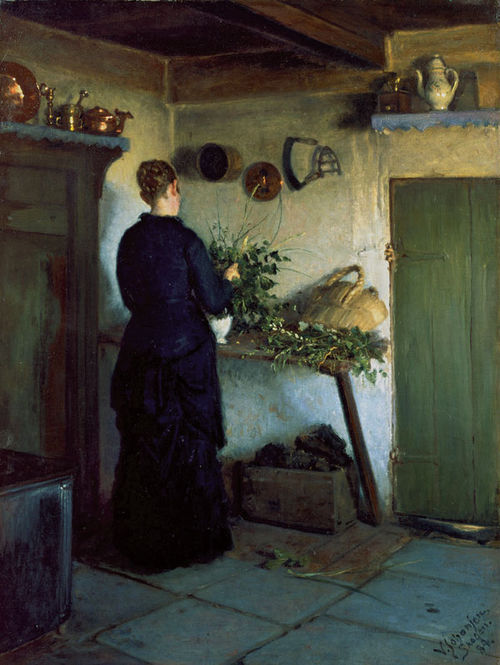
Hammershøi often painted views of Ida from behind, but this wasn’t a new or a unique pose to depict.

The German Romantic artist Caspar David Friedrich most famously used the idea more than eighty years before in his sublime work Wanderer above the Sea of Fog, but there were others, artist contemporaries of Hammershøi from the Scandinavian Skagen school, that used it too, most notably Viggo Johansen and Anna Ancher. But although Ida’s stance can be seen in this context, one that Degas often deployed too, Hammershøi’s use of it is much more introspectively Ibsenesque in its psychological depth – his backgrounds eschew the obvious drama of nature’s turmoil or the dynamism of domestic clutter and his figure becomes more intensely unreachable than any of these as a result.
Although we are aware of the outside world, thanks to the light pouring through the window, what is happening out there becomes irrelevant. The only world that counts is within, a private one. Its detail is important; we sense the books are carefully spine colour / subject-arranged and there is obsessive precision in the furniture and picture placement but the way that the artist catches the glint of light on the turned and highly polished (I can almost smell that polish) legs of the piano is another matter, as if the idea of imposed order even extends to the control of natural phenomena too. This is Vilhelm and Ida’s personal domain and although as viewers we are tacitly invited to see it, it feels like an encroachment.

This intimism is different from that practiced by Vuillard, Bonnard and Valloton in the same period; it shares more with some of the Dutch Golden Age masters like Pieter de Hooch or Vermeer whose scenes of domesticity capture a raptness, and engrossment in the everyday that takes on metaphysical qualities. In her book Artful, Ali Smith quotes the Polish poet Wislawa Syzmborska’s lines in her poem titled Vermeer:
So long as that woman from the Rijksmuseum
in painted quiet and concentration
keeps pouring milk day after day
from the pitcher to the bowl
the World hasn’t earned
the world’s end.

Hammershøi’s painting captures the same kind of mesmerised imperturbability; the kind that makes you feel that its time could persist forever. As long as Ida’s incommunicability persists in paint, then we haven't earned the right to disturb her or make her time end either.
I also think that there is tenderness in Interior. While at one level it is a study, like the famous painting of Whistler’s mother that Hammershøi admired and which strictly speaking is an
‘arrangement’ of tones rather than a portrait, the ‘woman’ of the title is not unimportant. Viewed from behind, demurely and simply dressed in a well-cut black dress, her waist cinched with satin that sheens as glossily as those piano legs, Ida’s attire suggests admirable elegance and sophistication, as decorous and modest as a porceline figurine. While the wearing of black can signify mourning or solemnity, here I think it indicates instead a certain formality that is attenuated by the exposure of the nape of her neck. There is a delicacy to this and a vulnerability that has appealed to the artist. He is depicting his wife with a loving fondness, even possibly desire or longing.
However, Ida’s place in the scene is also at one with the interior’s composition. Indeed, her composure is integral to the urbanity and refinement of the apartment. She adorns it as much as the piano and the books, and facilitates the play of light as much as any of the other inanimate objects that might be found there. It is in the soundless exchange between the ‘thingness’ of person, piano and interior that an allegory of the human condition is resolved.


Comments